How much memory for MacBook Pro: 24GB, 48GB, 64GB, or 128GB?

Can You Trust Amazon Laptop Reviews? What to Check Before Buying

About the Author
Sesera editorial account organizes laptop, mini PC, smartphone, and gadget buying guides so readers can check the important points before buying.
“This laptop has a 4.5-star rating on Amazon, but I still do not know whether it is safe to buy.”
“The reviews look positive, but I cannot tell whether they are for the exact same laptop configuration.”
That hesitation is reasonable. A laptop is not like a phone case or a cable. If you buy the wrong one, you may be stuck with weak performance, unclear warranty support, a different configuration, poor battery life, or a refurbished unit that does not match your expectations.
The practical answer is this: Amazon reviews are useful, but they should not be treated as permission to buy. Use reviews to find risk. Before buying a PC, check the seller, exact model number, CPU, memory, SSD, warranty, return conditions, low-star reviews, and whether the reviews actually match the configuration you are choosing.
This guide explains how to read Amazon laptop and desktop reviews without being misled by star ratings, short comments, mixed listings, unknown sellers, vague Office claims, and refurbished PC listings.
Use reviews to find risks first
Amazon reviews can help. The problem is using the average star rating as the decision. For PCs, the useful question is not “Is the rating high?” It is “Do the reviews reveal problems that matter for my use?”
Amazon explains its work to protect the review experience, including purchase-based signals and policies against misleading or incentive-driven reviews: Amazon’s trusted review experience. That does not remove the buyer’s job. You still need to check whether the reviews match the model, seller, and configuration you are about to buy.
| Review element | Useful for | Weak point |
|---|---|---|
| Average stars | Quick satisfaction signal | Does not explain why |
| Low-star reviews | Failure patterns | Shipping complaints may be mixed in |
| Photos | Real keyboard, ports, box, damage | May be another configuration |
| Verified Purchase | Amazon purchase signal | Does not prove technical accuracy |
| Seller name | Warranty and return path | Separate from the review score |
| Model number | Exact configuration check | Often hidden or unclear |
Treat reviews as evidence, not a verdict. A high rating is only useful after the basic product information is clear.
Read low-star reviews before praise
Start with the bad reviews. You are not looking for one angry buyer. You are looking for repeated patterns: weak battery, loud fan, overheating, poor screen, keyboard problems, unclear Office license, seller support issues, or repeated initial defects.
| Low-star complaint | How to judge it |
|---|---|
| Many initial defects | Avoid unless seller support is strong |
| Short battery life | Avoid for school, travel, or commuting |
| Loud fan noise | Bad for video calls and classes |
| Vague Office comments | Confirm whether it is Microsoft Office |
| Shipping box damage only | Separate from product performance |
| Warranty or return trouble | Check seller before buying |
A three-star review that says “Zoom was fine, but the fan was loud and the battery lasted only three hours” may be more useful than ten five-star reviews that only say “good product.”
Ignore stars when details are thin
Short praise is weak evidence for a PC. “Arrived fast,” “works well,” and “good value” do not tell you whether the laptop is good for video calls, office work, school assignments, photo storage, or family paperwork.
Useful reviews mention specific conditions: boot speed, fan noise, heat, keyboard feel, screen brightness, battery time, webcam, Wi-Fi, Office license, memory, storage, warranty support, or how the PC behaves after several weeks.
| Weak review | Useful review |
|---|---|
| Good laptop | Excel and browser tabs run smoothly |
| Fast delivery | Battery lasted about five hours |
| Nice design | Keyboard layout was hard to use |
| Cheap and good | 8GB memory slowed down with many tabs |
| Works fine | Fan noise was noticeable during calls |
If the reviews are mostly short and vague, do not let the star rating carry the purchase. Move back to the product page, seller, and warranty details.
Match reviews to the exact configuration
This is one of the easiest mistakes on Amazon. A single product page may contain several options: different memory, SSD size, CPU generation, screen size, bundled Office type, refurbished condition, or even a different year model.
Before trusting a review, check whether it refers to the same configuration you are buying. A review for a 16GB/512GB model does not prove that an 8GB/256GB model will feel the same. A review for a new unit does not prove the condition of a refurbished unit.
| Listing variation | Why it matters |
|---|---|
| 8GB vs 16GB memory | Changes multitasking comfort |
| 256GB vs 512GB SSD | Changes long-term storage comfort |
| CPU generation | Changes speed and battery behavior |
| Office included | May not mean Microsoft Office |
| New vs refurbished | Changes condition and warranty risk |
| Screen size | Changes portability and readability |
If the model number is unclear, the CPU name is vague, or the title and specs disagree, the listing is already weak before you even read the reviews.
Check seller and warranty before ratings
For a PC, the seller matters as much as the rating. Check who sells it, who ships it, where returns go, how warranty support works, and whether the seller is Amazon, the manufacturer, a known retailer, or an unfamiliar marketplace seller.
A cheap PC from an unknown seller with vague warranty information is not a safe main computer for work, school, family paperwork, or online banking. The purchase path matters because PCs sometimes need setup help, returns, repairs, or warranty claims.
If you are comparing Amazon, retail stores, and direct manufacturer stores, the English guide to home printer and computer needs also shows why support and compatibility can matter more than the lowest upfront price.
Treat refurbished PCs as individual-condition purchases
Refurbished PCs need a different level of caution. Reviews can tell you about seller behavior, but they cannot guarantee that your unit has the same battery condition, keyboard condition, storage health, cosmetic wear, or accessory set as another buyer’s unit.
A refurbished PC may be fine for a second machine or a limited budget, but beginners should not rely on a high star rating alone. Check the warranty period, return window, battery notes, Windows 11 support, Office license, and seller reputation.
| Refurbished PC check | Safer judgment |
|---|---|
| Warranty period | Longer and clearer is safer |
| Battery condition | Assume variation unless stated |
| Windows support | Avoid unsupported old models |
| Keyboard and exterior | Photos and condition notes matter |
| Office license | Confirm what is actually included |
| Seller support | Repeated complaints are a warning |
For a parent’s PC or a main work machine, a modest new laptop with clear warranty support may be the calmer choice. The English guide to protecting parents from PC support scams explains why old and confusing computers can create extra family support risk.
Watch for vague Office claims
Many PC shoppers search for “Office included.” That phrase is not enough. Confirm whether the listing means Microsoft Office, Microsoft 365 trial, a third-party office suite, web apps, or a license with unclear activation terms.
If you need Word, Excel, PowerPoint, school documents, business files, or compatibility with a workplace, do not assume that any “Office” wording is enough. Read the description, Q&A, and low-star reviews for complaints about activation or unexpected software.
| Office wording | What to confirm |
|---|---|
| Office included | Which Office and license type? |
| Microsoft 365 | Trial or paid subscription? |
| WPS or similar suite | Is that acceptable for your work? |
| Preinstalled Office | Activation method and account |
| No Office mention | Budget separately if needed |
Vague Office wording is not a small detail if the PC is for school, work, or family paperwork. It can change the real cost of the machine.
Use photos for layout and condition
Photo reviews can be useful because they reveal things polished product images hide: keyboard layout, port placement, screen reflections, scratches, box contents, AC adapter size, and whether the unit looks like a new or refurbished machine.
Photos are still not proof. They may show another configuration or another seller’s condition. Use photos as a practical check, then return to model number, condition, seller, and warranty.
| Photo detail | Why it helps |
|---|---|
| Keyboard layout | Avoid wrong-language or cramped keys |
| Ports | Confirm HDMI, USB-A, USB-C, card slots |
| Screen reflection | Matters for bright rooms |
| Box and accessories | Shows what arrived |
| Exterior wear | Important for refurbished units |
| Adapter size | Matters for carrying the laptop |
For laptops, a photo of the keyboard and ports can be more useful than another five-star sentence.
Avoid listings with repeated warning signs
Some listings are not worth rescuing with review analysis. If several warning signs appear together, skip the product and look for a cleaner listing.
| Warning sign | Why to avoid it |
|---|---|
| Very long title with no clear model | Hard to verify specs |
| CPU name without generation | Performance may be misleading |
| Office wording is vague | Real software cost is unclear |
| Seller and warranty are unclear | Return and repair risk |
| Reviews are mostly short | Little useful evidence |
| Reviews mention different products | Rating may not match your PC |
| Same low-star complaint repeats | Likely product or seller pattern |
| Return complaints are common | Bad if you receive a defective unit |
The cheaper the PC, the more these signs matter. A low price is not a win if the model, condition, warranty, and seller are unclear.
Buy only when the basics align
A PC is worth buying on Amazon when the purpose, specs, seller, warranty, return terms, and review evidence all point in the same direction. You do not need perfect reviews. You need clear information and acceptable risks.
| Check item | Safer target |
|---|---|
| Purpose | Matches office, school, calls, photos, or home use |
| Memory | 16GB for a comfortable main PC |
| SSD | 512GB for longer use when budget allows |
| Seller | Clear warranty and return path |
| Reviews | Low-star complaints are acceptable |
| Model number | Can be checked against other sources |
| Warranty | Clear before purchase |
If you are buying for sensitive family tasks such as passwords, banking, or paperwork, also think about the setup after purchase. The English guide to managing passwords for older parents explains why account recovery and device trust should be prepared before a new PC replaces an old one.
Choose from needs before reviews
If you feel lost in reviews, step back. Decide the use case first: office work, online classes, family photos, home printer setup, tax filing, video calls, or a parent’s main computer. Then choose the needed memory, storage, screen size, and support level.
Reviews are easier to read after the target is clear. A complaint about battery life matters if the laptop leaves the house. A complaint about fan noise matters if it is for video calls. A complaint about low storage matters if it will hold family photos.
If you need a broad starting point before checking Amazon listings, use Specsy’s PC buying check to narrow the basic requirements. After that, you can compare Amazon reviews more calmly. You can also check current laptop listings on Amazon, but do not buy until the seller, model number, warranty, and low-star reviews make sense.
The practical answer before buying
Amazon PC reviews are useful, but they are not something to blindly trust. Use them to find reasons not to buy. Read low-star reviews, check photos, confirm the seller, verify the exact model and configuration, and make sure warranty and return conditions are clear.
Do not buy a laptop just because it has a high star rating. Buy it when the product page is clear, the seller is credible, the configuration matches your needs, the low-star complaints are acceptable, and the warranty path is visible.
If the CPU, memory, SSD, Office wording, seller, or warranty is unclear, skip it. A cleaner listing with fewer doubts is usually the better PC purchase.
Frequently asked questions before buying
Can I trust Amazon laptop reviews?
Use them, but do not trust the star rating alone. Check low-star reasons, photos, seller, warranty, exact model number, and whether the reviews match the configuration you plan to buy.
Is a 4.5-star laptop safe to buy?
Not automatically. A 4.5-star laptop can still be a poor choice if the seller is unclear, the model number is vague, the warranty is weak, or the reviews are for different configurations.
What low-star reviews matter most for PCs?
Pay attention to repeated complaints about initial defects, battery life, fan noise, heat, keyboard, screen, Office activation, warranty support, and returns. Separate shipping-only complaints from product problems.
Are Amazon refurbished PC reviews reliable?
They help you judge the seller, but not the exact condition of your unit. For refurbished PCs, check warranty period, return terms, battery condition, Windows support, Office license, and seller complaints.
Should I buy the cheapest laptop with good reviews?
No. Very cheap laptops need extra checking. Confirm the CPU generation, memory, SSD, screen, seller, warranty, Office wording, and whether repeated low-star complaints point to real problems.
Compare specs on Specsy
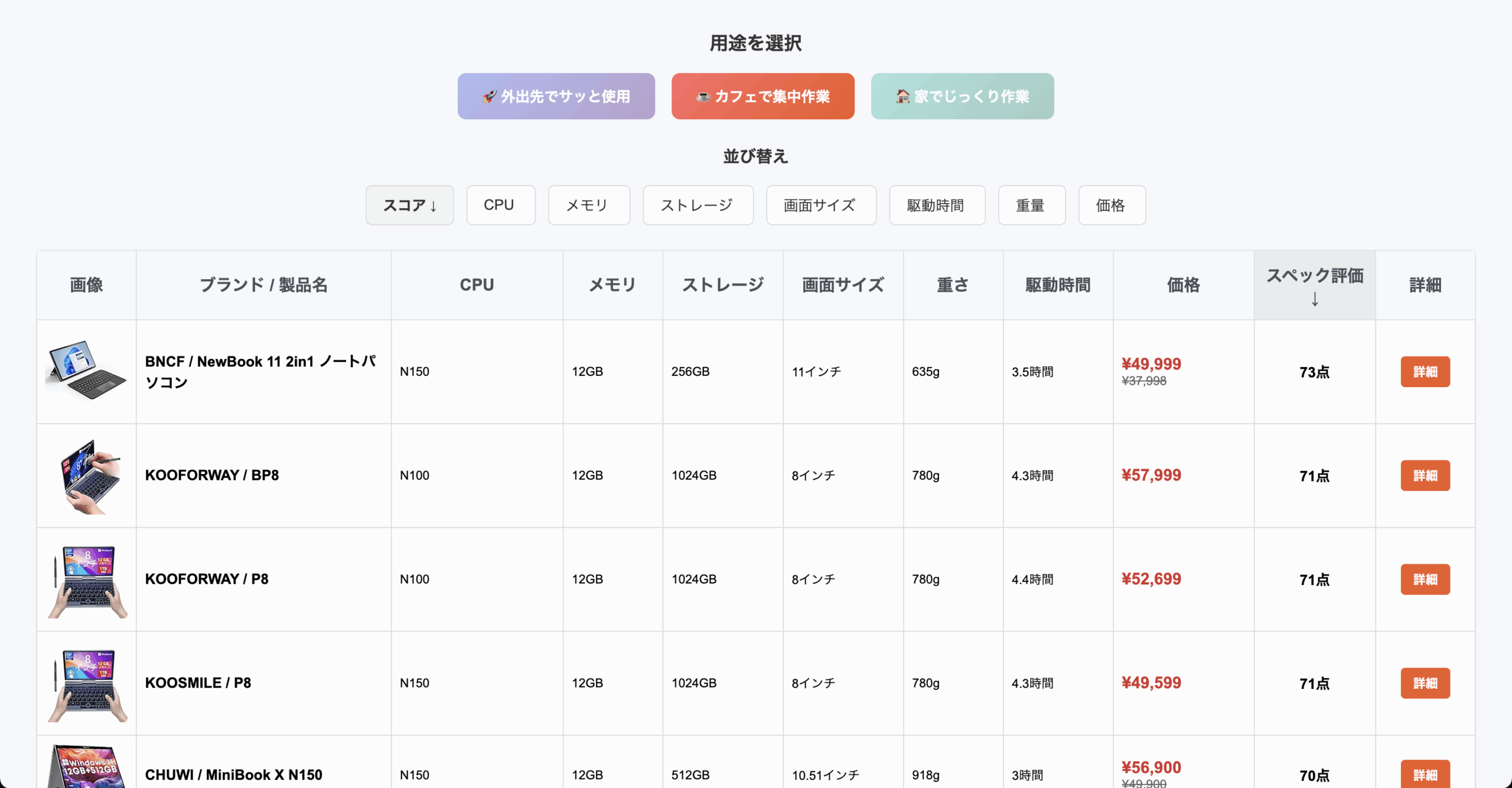
AmazonCompare compact Windows tablets, mini PCs, and laptops by specs and score.
Run by the same operator.
Related Articles
-


- iPad or iPad Air: Which Should You Buy for Notes, Study, and Storage?
- Mac mini M4 or M4 Pro: Which Chip Should You Choose?
- When to Buy a Computer for a Child: Elementary and Middle School Guide
- Best Computer for Photo Storage: SSD Size, Backup, and Family Photos
- Is iMac Good for College? Home Study, Campus Use, and MacBook Air
- Can You Use the iPad A16 for Work? Office, Meetings, and Laptop Limits
- iMac or MacBook Air: Which Should You Buy for Home, College, or Work?
- Is MacBook Neo good for Office? Word, Excel, PowerPoint, and 8GB RAM
- Is iPad Pro good for video editing? M5, storage, and Final Cut Pro
