Recommended Laptop Specs for College: Memory, Storage, Windows or Mac
Are Cheap Laptops on Amazon Worth It? Specs to Avoid Before Buying

About the Author
Sesera editorial account organizes laptop, mini PC, smartphone, and gadget buying guides so readers can check the important points before buying.
“Is it safe to buy a cheap laptop on Amazon?”
“Can a $300 or $400 laptop handle school, office work, video calls, and everyday use?”
The honest answer is this: a cheap Amazon laptop can be fine for light use, but only when the specs, seller, warranty, and return path are clear. For a main laptop, do not go below 16GB memory, a 512GB SSD, a Full HD screen, and a recent enough processor unless you know exactly what you are giving up.
The trap is buying only by price. A laptop can feel acceptable on the first day and then become frustrating when browser tabs, Office apps, Zoom, cloud sync, Windows updates, photos, and storage limits start piling up.
This guide explains when a cheap Amazon laptop is worth buying, which configurations to avoid, how to judge CPU, memory, SSD, Office wording, seller risk, and which uses need a stronger machine.
Cheap is fine for light use
A cheap Amazon laptop is not automatically bad. It can be a good choice for web browsing, YouTube, simple documents, online forms, email, family use, a child’s learning PC, or a secondary laptop that does not hold your whole digital life.
The problem starts when the cheapest laptop becomes the only computer for work, college, family paperwork, photos, video meetings, and long-term use. For that role, the safe baseline should be higher.
| Use case | Cheap laptop judgment | Safer minimum |
|---|---|---|
| Web and video | Usually fine | 16GB / 512GB if possible |
| Documents and email | Fine with the right specs | 16GB / 512GB / Full HD |
| College reports | Be more careful | 16GB / 512GB / portable body |
| Remote work | Do not underbuy | Core i5, Core 5, or Ryzen 5 class |
| Photo storage | Storage matters first | 512GB minimum, 1TB preferred |
| Video editing and gaming | Usually not a good fit | Stronger CPU, memory, and graphics |
If the laptop is cheap because it is simple but clear, it may be fine. If it is cheap because the specs, seller, warranty, or Office license are unclear, skip it.
Avoid weak memory and storage
Memory and storage are the two cheap-laptop compromises that hurt the most. A weak CPU can still be acceptable for simple tasks, but low memory and cramped storage affect everyday use again and again.
Avoid 4GB memory entirely for a new Windows laptop. I would also avoid 8GB as a main laptop for work, college, or long-term use. It may boot and run, but it leaves little room for browser tabs, documents, video calls, security software, and cloud sync at the same time.
For storage, avoid eMMC and HDD-only models as a main PC. Avoid 256GB SSD models unless the laptop is a secondary machine or you are truly cloud-first. A 512GB SSD is the practical minimum for a main everyday laptop.
| Part | Avoid | Safer target |
|---|---|---|
| Memory | 4GB, most 8GB main PCs | 16GB |
| Storage | eMMC, HDD-only, 128GB, 256GB main PCs | 512GB SSD |
| Screen | HD-only panels | Full HD or better |
| Office | Unclear “Office included” wording | Clear Microsoft 365 or known suite |
| Warranty | Vague seller support | Clear return and warranty path |
Treat budget CPUs by use
Budget processors such as Intel N100 or N150 can be useful in the right role. They are reasonable for web browsing, streaming, writing, light spreadsheets, online forms, and a secondary home laptop.
They are not the right target for heavy Excel work, photo editing, video editing, gaming, coding with heavier tools, or a main work laptop that needs to stay comfortable for years. For those uses, move toward a Core i5, Core 5, Ryzen 5, or better class of laptop.
Also watch old processor names. Very old Celeron, Atom, N4xxx, and N5xxx listings may be cheap because they are simply too weak or too old for a good Windows 11 experience.
Check the exact configuration
Amazon listings often combine several configurations on one page. One option may have 16GB memory and a 512GB SSD, while another has 8GB and 256GB. Reviews and star ratings can be mixed across those options.
Before buying, confirm the exact CPU, memory, SSD size, screen resolution, Windows version, Office wording, condition, seller, and warranty for the specific option in your cart. Do not rely on the title alone.
This is especially important for cheap laptops because the product title may be long, promotional, and packed with terms that sound better than the actual hardware. If the title, bullet points, and spec table disagree, treat that as a warning sign.
Read reviews to find problems
Reviews help, but they should not be used as permission to buy. Use them to find risk. Start with low-star reviews and look for repeated complaints about speed, battery life, heat, fan noise, keyboard, screen quality, Wi-Fi, Office activation, seller support, returns, or early failures.
A cheap laptop with many short positive reviews but repeated low-star complaints about the same defect is not a safe main PC. A slightly more expensive model with clearer specs and fewer serious complaint patterns is usually the better purchase.
For a deeper review check, use the Amazon laptop review checklist. The key point is the same: high stars are not enough when the seller, model, warranty, and exact configuration are unclear.
Do not trust vague Office wording
“Office included” can mean several different things. It may mean Microsoft Office, Microsoft 365, a trial subscription, a third-party office suite, web apps, or software with unclear activation terms.
If the laptop is for school, work, business files, or family paperwork, confirm exactly what is included. A vague Office claim can change the real price of the laptop if you later need to buy Microsoft 365 separately.
| Wording | What to confirm |
|---|---|
| Office included | Which Office suite and license? |
| Microsoft 365 | Trial, one-year, or separate subscription? |
| Office 2024 | Genuine license and activation method |
| WPS or similar | Whether it is acceptable for your files |
| No Office mention | Add software cost to the budget |
Judge seller and warranty early
A cheap laptop is only safe when the seller and support path are clear. Check who sells it, who ships it, whether returns are easy, how long the warranty lasts, and whether support comes from Amazon, the manufacturer, a known retailer, or an unfamiliar marketplace seller.
For a main laptop, avoid unclear seller names, vague warranty text, poor return complaints, or listings where buyers repeatedly mention support trouble. A low price is not worth much if the return or repair path is painful.
If you are buying in a physical store instead, the same logic applies. Ask about memory, SSD, warranty, return rules, and exact model before paying. The English guide to questions to ask before buying a laptop in a store gives a useful checklist.
Match the laptop to the job
Do not describe your workload too lightly. “Just office work” can mean one document at a time, or it can mean video meetings, browser tabs, spreadsheets, PDFs, chat apps, cloud storage, and a second monitor all running together.
For college, use the university or department requirements first. A cheap laptop may be fine for general reports, but it is the wrong choice if the course expects specific software, Windows-only tools, or heavier workloads. For that case, see recommended laptop specs for college.
| Job | Cheap laptop fit | Why |
|---|---|---|
| Streaming and browsing | Good fit | Light workload |
| Simple documents | Good with 16GB / 512GB | Basic tasks stay smooth |
| College main laptop | Conditional | School requirements matter |
| Remote work | Be careful | Calls and multitasking stack up |
| Photo storage | Storage-first decision | 256GB fills quickly |
| Video editing | Poor fit | CPU, memory, cooling matter |
| Gaming | Poor fit | Needs real graphics performance |
Spend more when it is main PC
The cheapest laptop can make sense as a secondary machine. It makes less sense as the computer you rely on every day for work, school, banking, passwords, documents, family photos, and video calls.
For a main PC, the safer target is 16GB memory, a 512GB SSD, a Full HD or better display, clear warranty support, and a processor that fits the job. If the laptop misses several of those points, the low price is probably hiding a future frustration.
For photo-heavy use, storage becomes even more important. The English guide to choosing a computer for photo storage explains why 512GB is only the minimum and 1TB is often the better family choice.
Choose after setting minimum specs
Set the minimum specs before opening Amazon rankings. Otherwise, the cheapest price, biggest discount label, or highest star rating will push you toward a weak configuration.
A practical starting filter is 16GB memory, 512GB SSD, Full HD screen, clear seller, clear warranty, and a processor that matches the job. After that, compare weight, battery, ports, keyboard, screen brightness, and reviews.
If you want a needs-based shortlist before reading Amazon listings, use Specsy’s PC buying check. If you already know you want a budget Windows laptop, compare current options here: budget laptops with 16GB memory and 512GB SSD on Amazon.
The safe answer before buying
A cheap Amazon laptop is worth considering when the job is light and the listing is clear. It can be enough for browsing, streaming, simple documents, online forms, and a secondary family PC.
For a main laptop, do not buy only because it is cheap. Avoid 4GB memory, weak 8GB main-PC configurations, eMMC storage, 256GB main laptops, old Celeron or Atom-class chips, HD-only screens, vague Office claims, unclear sellers, and weak warranty terms.
The simple buying line is this: if it cannot clearly meet 16GB memory, 512GB SSD, Full HD display, acceptable CPU, clear seller, and clear warranty, it should not be your main laptop.
Frequently asked questions before buying
Are cheap laptops on Amazon safe to buy?
They can be safe for light use when the specs, seller, warranty, and return terms are clear. For a main laptop, avoid models that fall below 16GB memory, 512GB SSD, a Full HD screen, and a clear support path.
What cheap laptop specs should I avoid?
Avoid 4GB memory, most 8GB main-PC configurations, eMMC storage, HDD-only models, 128GB or 256GB main laptops, old Celeron or Atom-class chips, HD-only screens, vague Office wording, and unclear sellers.
Is Intel N100 or N150 enough?
It is enough for web browsing, streaming, writing, light spreadsheets, online forms, and secondary use. It is not a good target for heavy Excel, photo editing, video editing, gaming, or a long-term main work laptop.
Is 8GB memory enough for a cheap laptop?
It can work for very light use, but I would not choose it for a new main laptop. For work, college, remote work, and longer use, choose 16GB memory.
Is 256GB SSD enough for everyday use?
It is tight for a main laptop. Windows, apps, documents, photos, downloads, and cloud sync can fill it quickly. Choose 512GB for a more comfortable everyday PC.
Compare specs on Specsy
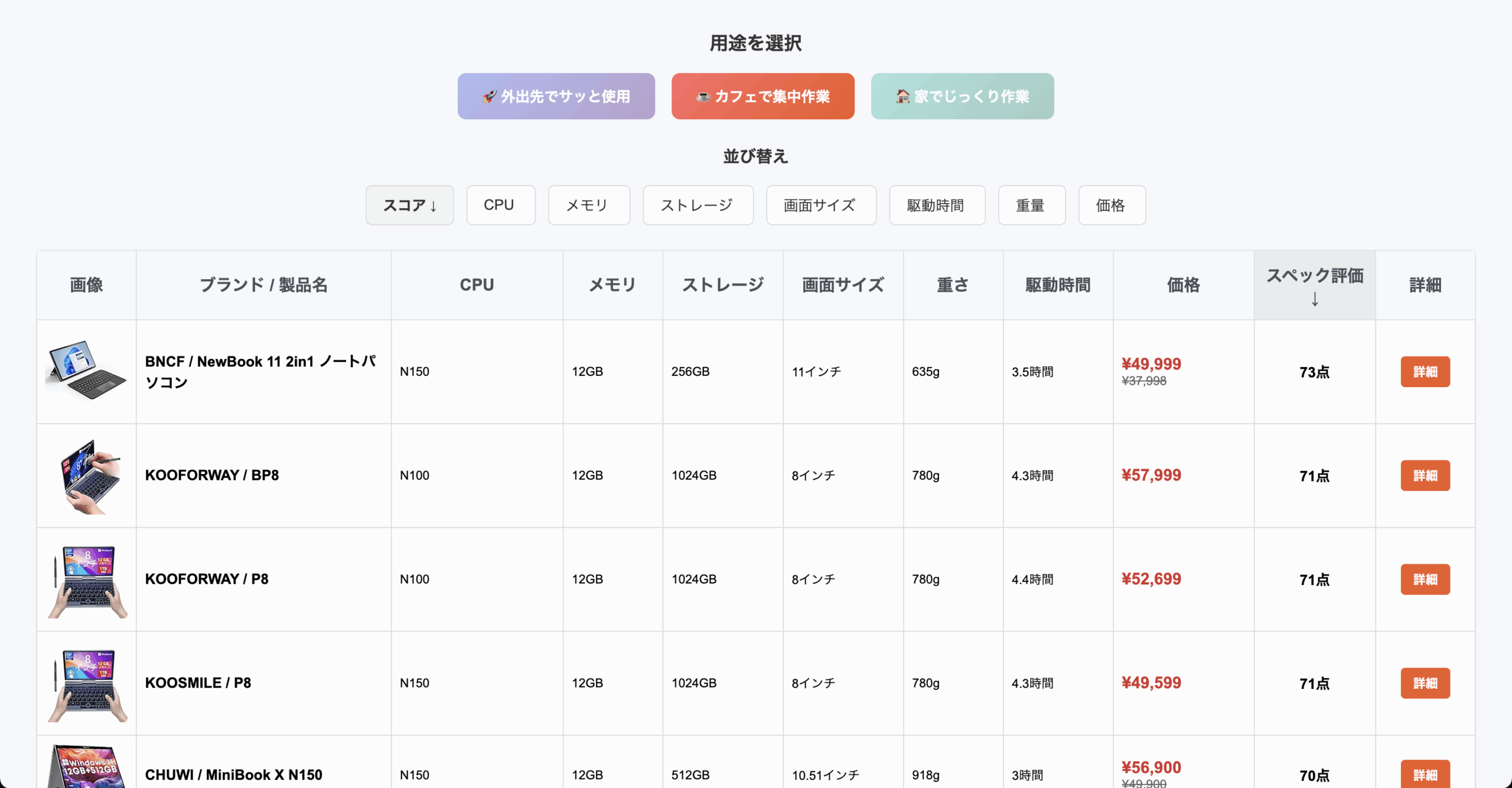
AmazonCompare compact Windows tablets, mini PCs, and laptops by specs and score.
Run by the same operator.
Related Articles
-


- Can the iPad Air Stream with OBS? M4, Screen Recording, and Mac Limits
- Is MacBook Air good for programming? M5, memory, and Docker limits
- Can the iPad Pro Stream with OBS? M5, Screen Recording, and Mac Limits
- Is the iMac Good for Illustrator and Photoshop? M4, Memory, and SSD Choices
- iPad Pro or MacBook Pro: Which Should You Buy for Creative Work?
- MacBook Air 13-inch or 15-inch: Which Size Should You Buy?
- Is the MacBook Air Good for Blender? M5, Memory, and 3D Limits
- Is the iMac Good for OBS Streaming? M4, Memory, Ports, and When to Skip It
- iPad or iPad Air: Which Should You Buy for Notes, Study, and Storage?
