Is the iPad A16 Good for Music Production? GarageBand, Logic Pro, and Storage
What to Ask Before Buying a Laptop in a Store

About the Author
Sesera editorial account organizes laptop, mini PC, smartphone, and gadget buying guides so readers can check the important points before buying.
“The salesperson recommended a laptop, but I am not sure whether it actually fits me.”
“The laptop looked affordable, but the quote became expensive after setup, warranty, Office, security software, and monthly support were added.”
If that feels familiar, do not treat the store recommendation as the final answer.
The practical answer is this: a retail store can be a good place to buy a laptop, but only if you separate the laptop itself from every add-on. Ask about the exact model, memory, storage, CPU generation, Office type, warranty coverage, setup work, data transfer, return policy, and total cost before you pay.
This guide gives you the questions to ask before buying a laptop in a store, plus what to take home if you want to compare it with Amazon, the manufacturer’s site, or another retailer.
Start with your use, not the model
The first question is not “Which laptop do you recommend?” That gives the store too much room to start from inventory, display models, bundles, or a promotion.
Start from your use. Say exactly what the computer must handle: school reports, college work, Microsoft Office, Zoom, remote work, family photos, printing, scanning, light gaming, or travel. A vague answer like “normal use” usually leads to a vague recommendation.
A better question is: “For this use, what memory, storage, CPU, screen size, and warranty level do I actually need?” If the answer stays vague, do not buy yet.
| Ask about | Good store answer | Weak answer |
|---|---|---|
| Use case | Office, calls, photos, school, or work are separated | “It can do everything” |
| Memory | 16GB for a main Windows PC | “8GB is fine” without context |
| Storage | 512GB SSD or clear cloud/external plan | “Cloud storage will handle it” |
| CPU | Exact model and generation are explained | “It is Core i5, so it is fast” |
| Office | Microsoft 365, Office, or compatible suite is named | “Office included” |
| Warranty | Failure, accident, term, deductible, and data limits are clear | “You are covered” |
| Total cost | Device, setup, warranty, and monthly fees are separated | “Monthly payments make it cheap” |
Ask for memory before screen size
The screen is what you see first in a store, but memory affects how the laptop feels every day. For a main Windows laptop, ask for 16GB memory unless the use is truly light.
An 8GB laptop can still work for simple web browsing, streaming, and basic documents. It is not the configuration I would choose for a main PC used for work, college, family photos, browser tabs, video calls, and cloud sync.
Microsoft publishes minimum Windows 11 requirements, but minimum requirements are not the same as a comfortable buying target. See the Windows 11 system requirements.
Check storage against photos and files
For a main laptop, ask whether the SSD is 512GB. A 256GB SSD can be usable, but it gets tight faster than many buyers expect once Windows, Office, photos, PDFs, downloads, phone backups, and cloud sync are involved.
If the salesperson says cloud storage makes a small SSD fine, ask which cloud service, how much it costs, and what happens when you stop paying. Cloud storage is useful, but it should be a deliberate choice, not a way to hide a cramped laptop configuration.
For families with photos, scanned documents, school files, and old data to move, 512GB is the more comfortable baseline. If the budget cannot reach that, make the tradeoff knowingly.
Do not accept CPU labels alone
“Core i5” or “Ryzen 5” is not enough information. CPU generation and exact model matter. A newer midrange processor can be a better buy than an older processor with a more impressive label.
Ask three short questions: “What is the exact CPU model?” “Is this a current or older generation?” “Will it handle video calls, Office, and multiple browser tabs at the same time?”
If you need video editing, games, programming, or heavy creative work, ask directly whether this store model is actually built for that. Many attractive retail laptops are designed for office and household use, not sustained heavy workloads.
Confirm what Office really means
When a store says “Office included,” ask what that means. It may be Microsoft 365, a perpetual Microsoft Office license, a trial, or a compatible office suite with similar-looking apps.
If school or work requires Word, Excel, PowerPoint, or file compatibility, choose the real Microsoft option or confirm that your organization accepts alternatives. Microsoft publishes system requirements for Microsoft 365, which can help you verify that the device is in a reasonable range. See Microsoft 365 system requirements.
If you already have Microsoft 365 through school, work, or family sharing, paying again through a bundle may be unnecessary. Ask before accepting the quote.
Separate warranty from sales pressure
A warranty is not automatically bad. For a student, commuter, family laptop, or work machine that gets carried around, accident coverage can be useful. For a home-only laptop that rarely moves, the same plan may be less valuable.
Ask what is covered: natural failure, drops, spills, battery, screen damage, shipping, repair time, deductible, replacement rules, and data handling. Also ask what is not covered.
If the warranty explanation stays at “you will be protected,” do not decide yet. You need the written terms, not only the sales pitch.
Treat setup fees as optional help
Setup service can be worth paying for when the buyer is not comfortable with Microsoft accounts, Wi-Fi, email, printer setup, browser setup, updates, and security settings. It can also be useful when buying for an older parent.
But setup fees are not automatically necessary. Ask exactly what the store will do. If the service is mainly opening the box, creating an account, running updates, and installing a trial security app, you may be able to do it yourself.
Also ask whether the setup creates or changes passwords. If it does, make sure the buyer keeps the account information, recovery email, phone number, and sign-in method. For family account planning, see how to manage passwords for older parents.
Pay for migration only when needed
Data transfer is valuable when the old computer has years of photos, email files, desktop folders, bookmarks, tax documents, accounting software, iTunes data, or an old address book. In those cases, paying for help can prevent a messy transition.
If most files are already in OneDrive, Google Drive, iCloud, Dropbox, or an external SSD, full paid migration may be unnecessary. Ask what data will be moved, what will not be moved, and whether the old PC will be wiped afterward.
Do not pay for a vague “data transfer” line item without a list. The hard part is not copying random files. It is making sure the files that matter are actually usable on the new computer.
Take the exact quote home
If you are not in a hurry, do not decide at the counter. Take home the exact model number and the full quote. A verbal explanation is too hard to compare later.
| Take home | Why it matters |
|---|---|
| Exact model number | Retail displays can hide small configuration differences |
| CPU model | Labels like Core i5 are not enough |
| Memory and SSD size | These affect everyday comfort |
| Office type | Microsoft, subscription, trial, or compatible suite differ |
| Base laptop price | You need it separated from services |
| Setup and migration fees | These may be optional |
| Warranty cost and coverage | Term alone is not enough |
| Monthly contracts | Small monthly fees change the real cost |
| Return and exchange period | You need to know the deadline before opening everything |
With that information, compare the same or similar configuration online. If you use Amazon, do not rely only on the star rating. Check seller, model number, warranty, low-star reviews, and configuration details. I cover that process in how to read Amazon laptop reviews before buying.
Cut duplicate services from the quote
The easiest place to overspend is not always the laptop. It is duplicate services added around the laptop: Office, Microsoft 365, security software, cloud storage, support plans, setup, migration, and warranty.
Ask for three totals: laptop only, laptop with setup, and laptop with warranty and all services. Seeing those totals separately makes the decision much clearer.
| Quote item | May be cut when | May be worth keeping when |
|---|---|---|
| Setup service | You can handle accounts and updates | The buyer is not comfortable setting up a PC |
| Security software | You understand Windows built-in protection | The buyer needs guided family support |
| Office bundle | You already have a valid license | School or work requires Microsoft apps |
| Extended warranty | The laptop stays at home | It will be carried daily |
| Data migration | Your files are already synced or backed up | Old photos, email, and app data matter |
| Monthly support | You will not call or use it | The buyer needs phone support |
Buy only when you can explain it
Buy in the store only when you can explain the choice in plain language: why this model, why this memory, why this storage, why this warranty, and why the total price makes sense.
If you cannot explain it yet, pause. Take the quote home, compare exact or similar models, and check whether the add-ons are useful for your situation. For a needs-based shortlist, you can start with Specsy’s PC buying check. To compare current online options, you can also review listings such as Windows 11 laptops with 16GB memory and 512GB SSD on Amazon.
The practical answer for store buying
Buying a laptop in a retail store is not a bad choice. You can touch the device, compare screens and keyboards, ask questions, and get help if the buyer is not comfortable setting up a PC.
The risk is buying the bundle instead of the laptop. Separate the base computer, Office, warranty, setup, migration, security software, cloud storage, and monthly plans. If the exact model and total cost still make sense after that, the store can be a good place to buy. If not, take the quote home and compare before paying.
Frequently asked questions before buying in store
What should I ask before buying a laptop in a store?
Ask about the exact model number, CPU model and generation, memory, SSD size, Office type, warranty coverage, setup fee, data transfer fee, monthly contracts, return period, and total price without optional services.
Should I buy the laptop a salesperson recommends?
Only if you can explain why it fits your use and total budget. If the recommendation is based on vague phrases like “good for everything” or “monthly payments are low,” take the quote home and compare before buying.
Is store setup service worth paying for?
It can be worth it for beginners, older parents, or buyers who need help with accounts, email, Wi-Fi, printer setup, and updates. It is less necessary if you can handle basic setup yourself.
What add-ons should I check carefully?
Check Office, Microsoft 365, security software, cloud storage, extended warranty, data migration, and monthly support. Some are useful, but they can also duplicate services you already have.
Is it better to buy online instead?
Online can be cheaper and easier to compare, but stores are useful when you want to see the screen, keyboard, size, and support options in person. The best choice is the one where the exact configuration and total cost are clear.
Compare specs on Specsy
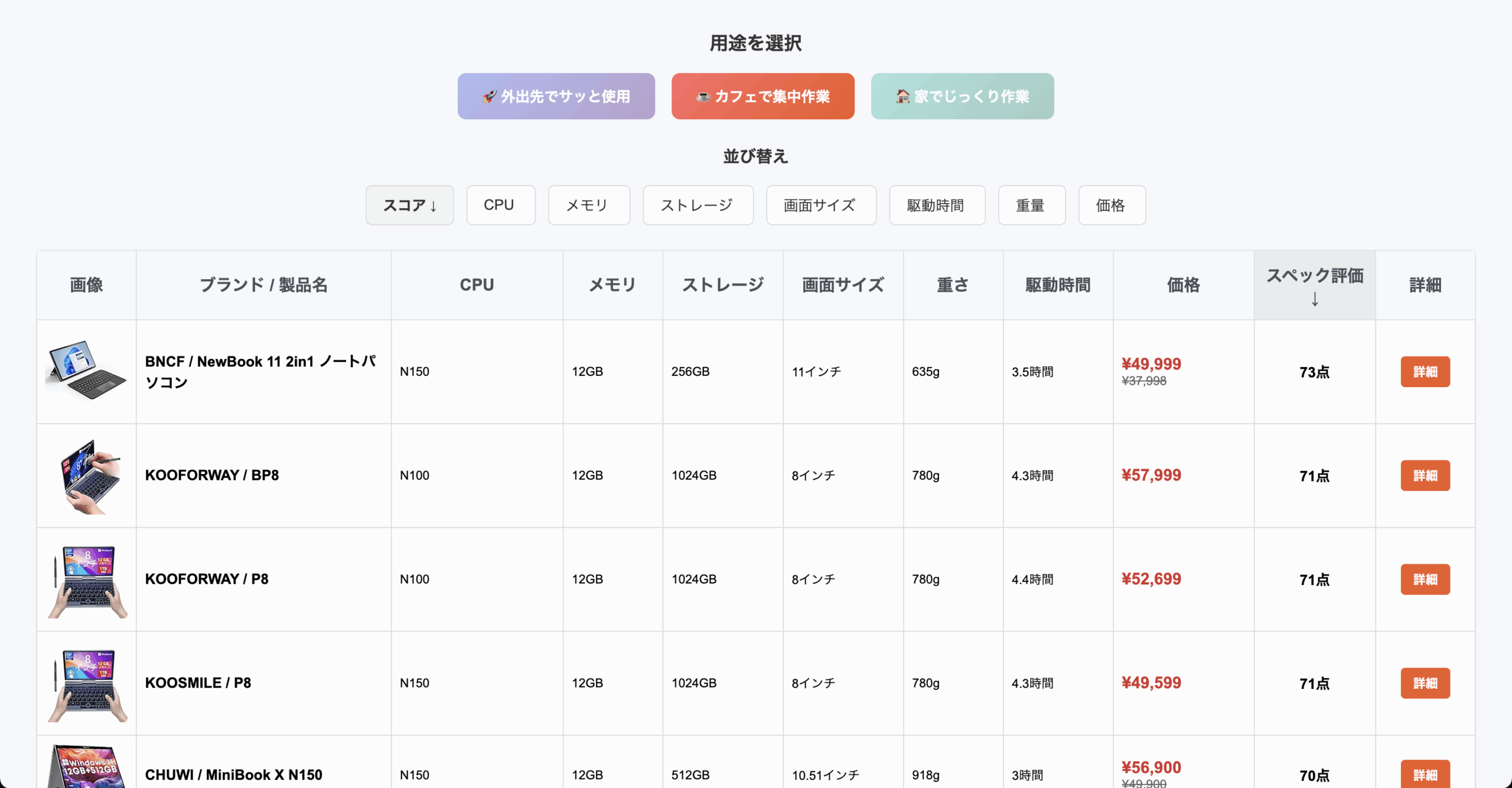
AmazonCompare compact Windows tablets, mini PCs, and laptops by specs and score.
Run by the same operator.
Related Articles
-


- Can an iPad Pro Replace a Laptop for Work? Office, External Monitor, and MacBook Limits
- How Much iPad Storage Do You Need: 128GB, 256GB, 512GB, 1TB, or 2TB?
- Is MacBook Air good for AI development? M5, memory, and local AI limits
- Is the MacBook Pro Good for Music Production? M5 Pro, Memory, and Storage
- Is the Mac mini Good for Music Production? M4, M4 Pro, Memory, and Storage
- Is MacBook Neo good for Office? Word, Excel, PowerPoint, and 8GB RAM
- Best Laptop Brands by Use: Work, College, Home, and Creative Tasks
- Is MacBook Air good for programming? M5, memory, and Docker limits
- Recommended Laptop Specs for College: Memory, Storage, Windows or Mac
