How much SSD storage for MacBook Air: 512GB, 1TB, 2TB, or 4TB?
MacBook Pro 14-inch or 16-inch: Which Size Should You Buy?

About the Author
Sesera editorial account organizes laptop, mini PC, smartphone, and gadget buying guides so readers can check the important points before buying.
"Should I buy the 14-inch MacBook Pro, or is the 16-inch model worth the extra screen space?"
"If I choose M5 Pro or M5 Max, should I automatically move up to the larger MacBook Pro?"
The practical answer is simple: choose the 14-inch MacBook Pro if the laptop will move with you. Choose the 16-inch MacBook Pro if the built-in screen will be your main workspace for long creative or technical sessions.
The common mistake is treating the bigger model as the more professional choice. A 16-inch MacBook Pro is easier to work on when you edit video, code, mix music, or manage complex timelines without a monitor. It is also much more laptop to carry. If you mostly work at a desk with an external display, the 14-inch model can be the smarter Pro.
This guide compares the two sizes in the order that usually matters: carry versus desk use, weight, display workspace, chip choice, video editing, development, music production, external monitors, memory, storage, Mac mini, and the final pre-purchase check.
Start with carry versus desk use
Before comparing M5, M5 Pro, and M5 Max, decide where the MacBook Pro will actually be used. The 14-inch model is the safer choice for a laptop that travels. The 16-inch model is better when the laptop is closer to a movable workstation.
Apple lists the current MacBook Pro in 14-inch and 16-inch sizes. The 14-inch model can be configured with M5, M5 Pro, or M5 Max, while the 16-inch model starts in the M5 Pro and M5 Max class. That makes the 16-inch model less of a general laptop and more of a pro workspace.
Sources:
Apple MacBook Pro overview
Apple MacBook Pro technical specifications
| Main use | Better size | Why |
|---|---|---|
| Daily commuting | 14-inch | Easier to carry, pack, and open anywhere |
| Travel or campus use | 14-inch | Less weight in the bag matters every day |
| External monitor at desk | 14-inch | The monitor handles the workspace problem |
| Video editing on the laptop | 16-inch | Timeline, preview, and panels have more room |
| Development without a monitor | 16-inch | Code, docs, terminal, and browser are easier to split |
| Music production and design | 16-inch | Tracks, plug-ins, canvas, and tools feel less cramped |
| One fixed desk only | Mac mini | A notebook may not be the cleanest setup |
Choose 14-inch when the laptop moves
Choose the 14-inch MacBook Pro if you work between home, office, school, client sites, studios, cafes, trains, or hotel rooms. It is still a Pro laptop, not an ultralight MacBook Air, but it stays within the range where carrying it every day is realistic.
This is also the better size when you already have a monitor at your main desk. Use the built-in screen when mobile, then plug into a larger display when you need more room. That combination often beats buying the bigger laptop and carrying the extra weight all the time.
Related guides:
MacBook Pro vs Mac mini for creative work, development, and portability
Best external monitor setup for a laptop
Choose 16-inch for built-in workspace
Choose the 16-inch MacBook Pro when the built-in display is the workspace. That means long editing sessions, full-screen creative apps, side-by-side reference material, multiple terminal panes, large design canvases, music sessions with plug-ins, or local AI and 3D work where you need to see more at once.
The 16-inch model does not remove the need for a monitor in every setup. A good desktop display is still larger. The difference is that the 16-inch MacBook Pro makes the laptop-only setup much less cramped when you are away from your main desk.
Weight is the first real tradeoff
Apple lists the 14-inch MacBook Pro at 3.4 pounds for M5, 3.5 pounds for M5 Pro, and 3.6 pounds for M5 Max. In metric terms, that is 1.55 kg, 1.60 kg, and 1.62 kg. It is not featherlight, but it is still a laptop you can reasonably carry every day.
The 16-inch MacBook Pro is listed at 4.7 pounds, or 2.14 kg with M5 Pro and 2.15 kg with M5 Max. That is a different category. It is fine for moving between desks, taking to a studio, or travelling when the larger screen pays for itself. It is not the size I would choose for a packed commute, small classroom desk, or walking around all day.
The numbers matter because they change behavior. A laptop that is slightly annoying to carry becomes a laptop you leave behind. If portability is part of the value, the 14-inch model should be your default.
Screen size changes the workflow
Apple lists the 14-inch model with a 14.2-inch Liquid Retina XDR display and the 16-inch model with a 16.2-inch Liquid Retina XDR display. The difference is not just two diagonal inches. It is how much room apps have before panels, timelines, toolbars, and browser windows start fighting each other.
For writing, browsing, email, meetings, light photo edits, and coding with an external monitor nearby, 14-inch is enough. For timeline work, large spreadsheets, long code sessions, music production, design tools, and split-screen reference, 16-inch feels more honest if you work on the laptop display itself.
Do not buy 16-inch only because bigger looks better in a store. Buy it because you can name the app layout that needs the room.
M5, M5 Pro, and M5 Max do not decide size alone
The chip choice and size choice are related, but they are not the same decision. M5 in the 14-inch model fits lighter pro work, general productivity, study, photo work, and moderate creative use. M5 Pro is the balanced choice for people who regularly edit video, develop software, run heavier multitasking, or work with production apps. M5 Max is for high-end GPU, media, AI, 3D, and heavy creative workloads.
Apple says the 14- and 16-inch MacBook Pro models with M5 Pro and M5 Max target demanding creative and technical workflows, including video editing, music production, design work, and local AI work. That does not mean every M5 Pro buyer needs 16-inch. It means the workload is heavy enough that screen, memory, storage, thermals, and desk setup all deserve attention.
Source:
Apple Newsroom: MacBook Pro with M5 Pro and M5 Max
| Chip direction | Who it fits | Size direction |
|---|---|---|
| M5 | General work, study, lighter creative tasks | 14-inch |
| M5 Pro | Video editing, development, DTM, heavier multitasking | 14-inch if mobile, 16-inch if laptop screen matters |
| M5 Max | 3D, AI, high-resolution video, heavy GPU work | 16-inch if mostly desk-based, 14-inch if mobility wins |
Video editors should choose by monitor use
For video editing, the size question is really a monitor question. If you edit at a desk with a large external display, the 14-inch MacBook Pro is often the better laptop. You get the Pro performance when docked and a more manageable machine when mobile.
If you edit mainly on the built-in screen, choose 16-inch. Timeline, preview, media browser, color controls, audio meters, captions, and effects panels are simply easier to manage with more room. The heavier laptop is easier to defend when it directly reduces friction during paid or frequent work.
Related guides:
MacBook Pro memory guide: 24GB, 48GB, 64GB, or 128GB
MacBook Pro SSD guide: 1TB, 2TB, 4TB, or 8TB
Developers need screen space or a dock
For development, 14-inch is the better mobile size. It is easier to carry to meetings, classes, coworking spaces, and trips. At a desk, an external monitor solves the biggest limitation by giving you room for the editor, browser, logs, docs, terminal, and chat.
Choose 16-inch if you often code away from a monitor for hours. The extra space helps when you keep documentation beside code, watch logs while debugging, run local tools, or compare multiple files. The performance decision still depends on your workload, but the comfort decision is clearly tied to screen space.
Music, design, and 3D favor the larger screen
Music production, design, and 3D work are strong reasons to consider 16-inch. Tracks, plug-in windows, piano roll, mixers, layer panels, reference images, node views, and 3D viewports all become harder to manage on a smaller laptop display.
The 14-inch MacBook Pro still makes sense for mobile recording, live work, travel, and people who return to a larger screen at the desk. The 16-inch model is better when the laptop display is not a backup screen, but the main place where work gets finished.
External monitors make 14-inch easier to defend
If you use an external monitor most days, the 14-inch MacBook Pro becomes much easier to recommend. The smaller laptop handles travel, and the monitor handles the workspace. That split is more practical than carrying a heavier 16-inch model just to solve a problem that your desk already solves.
If you do not use a monitor and do not plan to buy one, the 16-inch model has a clearer role. It gives you a larger workspace everywhere: home, studio, client office, hotel, train table, and temporary setups.
Related guides:
Laptop external monitor guide: USB-C, HDMI, and resolution
Memory and storage matter before screen bragging rights
Do not spend the whole budget moving from 14-inch to 16-inch if the real bottleneck is memory or storage. For heavy creative work, development, local AI, large photo libraries, long video projects, and multi-app sessions, memory and SSD choices often matter more than the diagonal size.
A well-configured 14-inch MacBook Pro with enough memory, enough SSD, and a good external monitor can beat an under-configured 16-inch model for real work. The larger screen is valuable, but it should not be the upgrade that forces you into cramped storage or too little memory.
Related guides:
MacBook Pro memory guide
MacBook Pro SSD storage guide
Fixed desk users should compare Mac mini
If the Mac will stay on one desk, compare Mac mini before buying a MacBook Pro. A desktop setup can give you a larger monitor, better keyboard position, more comfortable ergonomics, external storage, and cleaner cable management. In that setup, the laptop screen and battery may not be worth paying for.
Buy MacBook Pro when portability is real. Buy Mac mini when the computer is part of a fixed workstation. This decision often matters more than 14-inch versus 16-inch.
Related guides:
MacBook Pro vs Mac mini for creative work and portability
Mac mini vs MacBook Air for desk use, portability, and total cost
The safer choice before checkout
Choose the 14-inch MacBook Pro if you carry the laptop often, work in multiple places, use an external monitor, travel, study, commute, or want the most flexible Pro notebook.
Choose the 16-inch MacBook Pro if you finish real work on the built-in display: video editing, coding without a monitor, DTM, design, 3D, local AI work, or long production sessions where workspace directly affects speed.
My default is simple: 14-inch for a MacBook Pro you carry, 16-inch for a MacBook Pro you work on as a self-contained workstation. If you cannot name the task that needs the larger screen, buy 14-inch and put the budget toward memory, SSD, AppleCare, or a good external monitor.
Still choosing between MacBook Pro, Mac mini, and other laptops?
Compare the setup around your real work: portability, monitor use, memory, SSD, creative apps, development tools, and total cost.
Useful US Amazon searches
Use these as search shortcuts only. Confirm the exact chip, memory, SSD, keyboard layout, seller, warranty, return policy, and whether the listing is new or refurbished before buying.
Frequently asked questions about MacBook Pro size
Should I buy the 14-inch or 16-inch MacBook Pro?
Choose the 14-inch MacBook Pro if you carry it often, travel, work between locations, or use an external monitor at a desk. Choose the 16-inch MacBook Pro if the built-in display is your main workspace for video editing, development, music production, design, or 3D work.
Is the 16-inch MacBook Pro too heavy?
It is heavy for daily carry. Apple lists the 16-inch MacBook Pro at 4.7 pounds, or 2.14 to 2.15 kg depending on chip. That weight is fine for desk-to-desk movement and occasional travel, but it is a lot for commuting or campus use.
Is 14-inch enough for video editing?
Yes, especially if you use an external monitor at your desk. The 16-inch model is better when you edit for long sessions on the built-in display, because the timeline, preview, media browser, and controls feel less cramped.
Should M5 Pro or M5 Max buyers choose 16-inch?
Not automatically. M5 Pro is reasonable in either size. M5 Max is easier to justify with the 16-inch model if you run long heavy workloads and mostly work at a desk, but mobile creators can still prefer the 14-inch model.
Should I buy a Mac mini instead?
If the computer will stay on one desk with a large monitor, keyboard, external SSD, and other accessories, Mac mini can be the cleaner setup. Buy MacBook Pro when you genuinely need notebook portability or a powerful built-in display.
Compare specs on Specsy
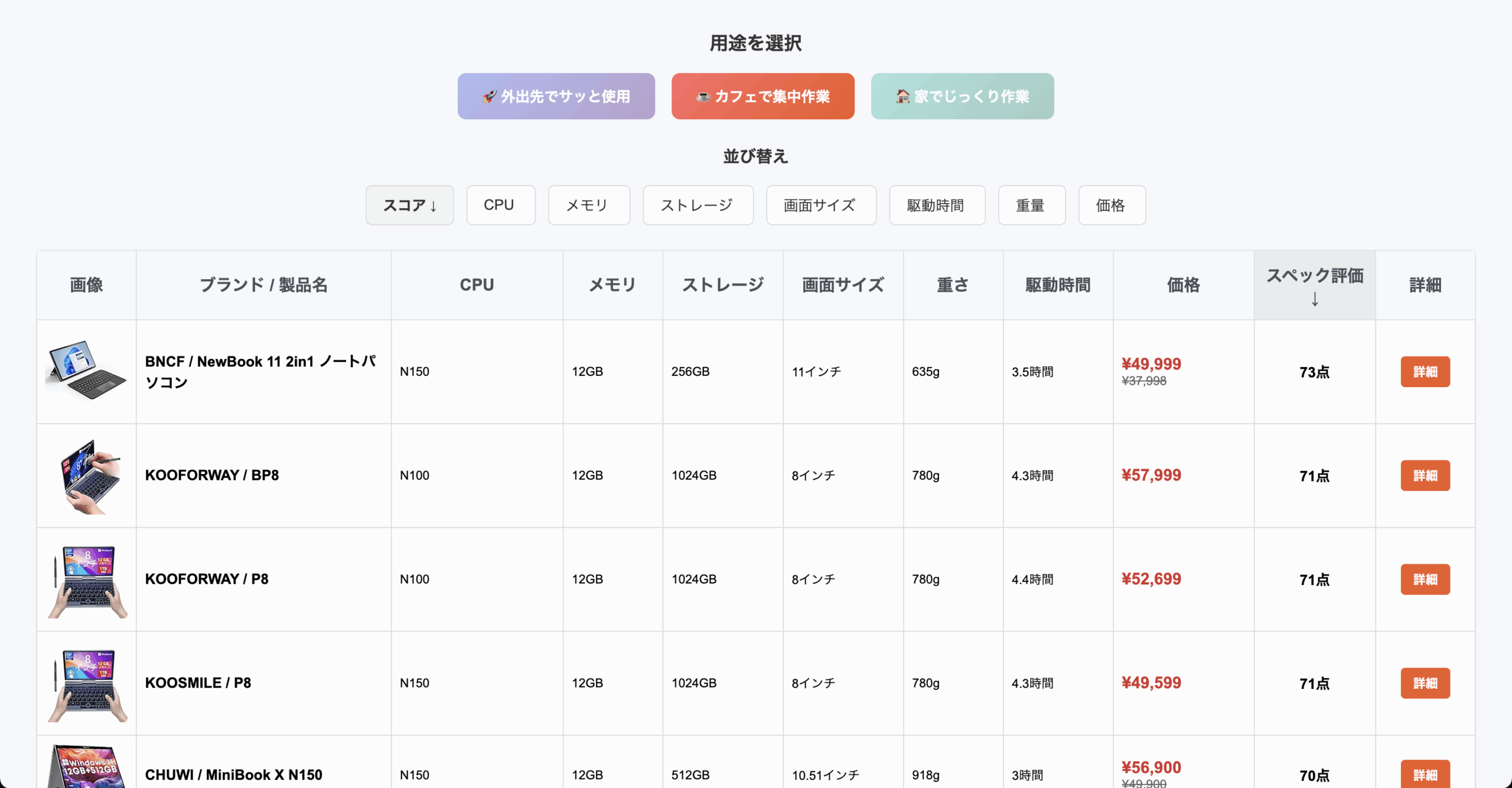
AmazonCompare compact Windows tablets, mini PCs, and laptops by specs and score.
Run by the same operator.
Related Articles
-


- Is the iMac Good for Illustrator and Photoshop? M4, Memory, and SSD Choices
- How much SSD storage for MacBook Pro: 1TB, 2TB, 4TB, or 8TB?
- iPad or iPad Air: Which Should You Buy for Notes, Study, and Storage?
- Is the MacBook Pro Good for Blender? M5 Pro/Max, Memory, and GPU Guide
- Is MacBook Neo good for remote work? Zoom, Office, 8GB RAM, and limits
- Is the iPad A16 Enough for Study Notes? Storage, Pencil, and iPad Air Differences
- Is the MacBook Pro Good for Illustrator and Photoshop? Memory and SSD Guide
- Mac mini for programming: M4 vs M4 Pro, memory, and Docker
- How to Manage Passwords for Older Parents: Accounts, 2FA, Recovery
